AI powered intent setup
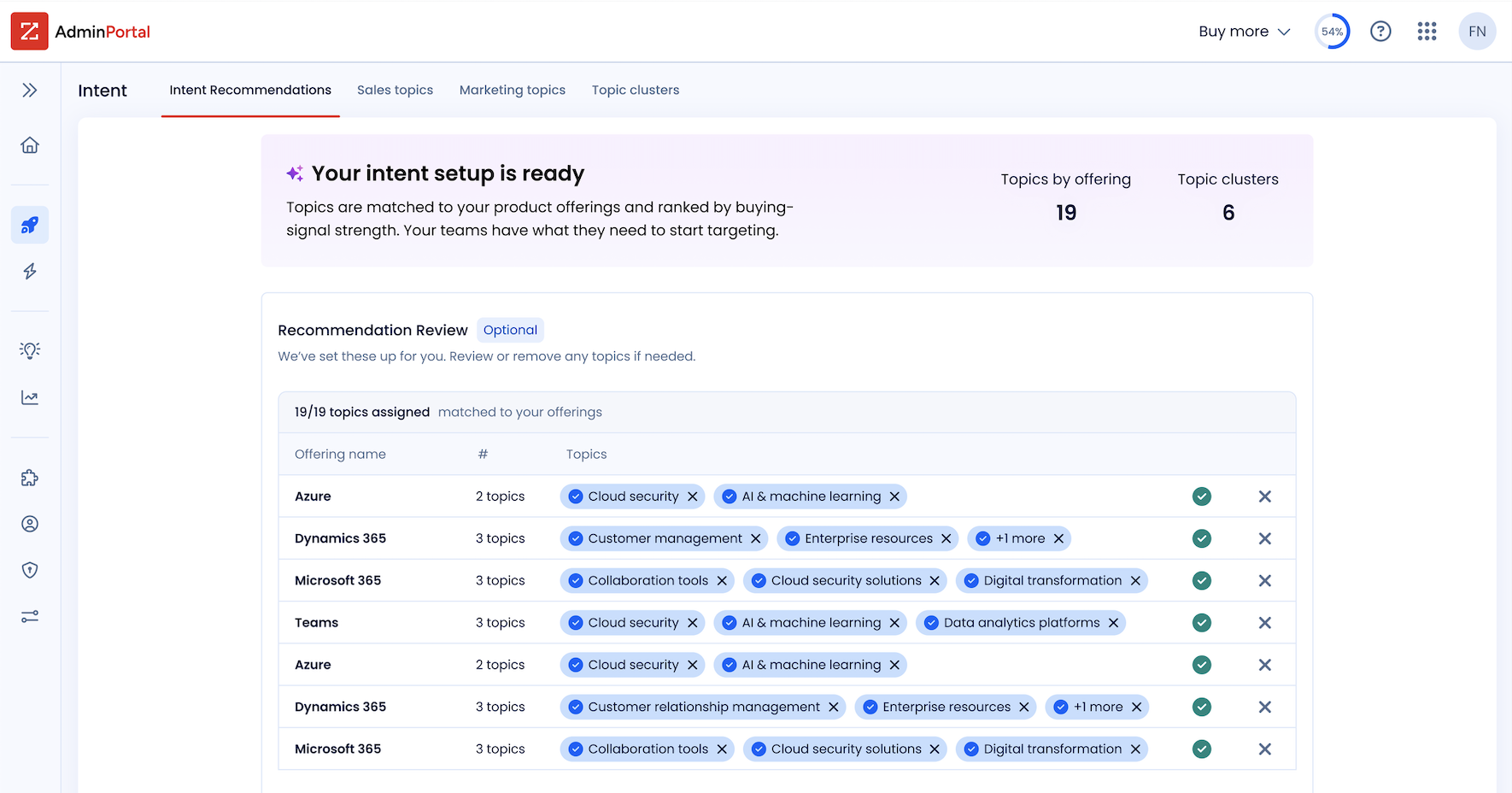
TL;dr Redesigned AI-powered Intent onboarding, reducing enterprise setup from hours to minutes for 30k+ admin users.
Role Timeline Team Impact
Lead Product Designer 2 months PM + 5 Engineers Reduced onboarding friction
AI tools used: (make graphic with logos)
Claude (logo) → systems thinking / orchestration / edge cases
Google Stitch → onboarding ideation
Claude Code → state testing / cascading logic
Responsibilities
Defined product requirements
Led AI ideation and strategy
Concept user-testing w/ Onboarding Managers
High-fidelity UI in Figma
The Problem
A FRAGMENTED ONBOARDING ECOSYSTEM
Before
Admins were handed a flat list of 5,000+ topics. A 1-month average TTV. Customer Success spent up to 5 hours per customer
(replace image with before and after side by side)
"I don't even know where to start… there's so many topics and I don't know which ones actually matter for my business."
— Customer from study
Building from Scratch
There were no clear requirements, so I made my own.
I fed the roadmap and user research into a Claude project to define the onboarding strategy from the ground up.
Key Feature Challenges
Support 50+ Offerings with intent signals
Reduce manual setup and cognitive overload
Create scalable onboarding for enterprise admins
Design for complex multi-state recommendation flows
The feature concept
Strategic Shift
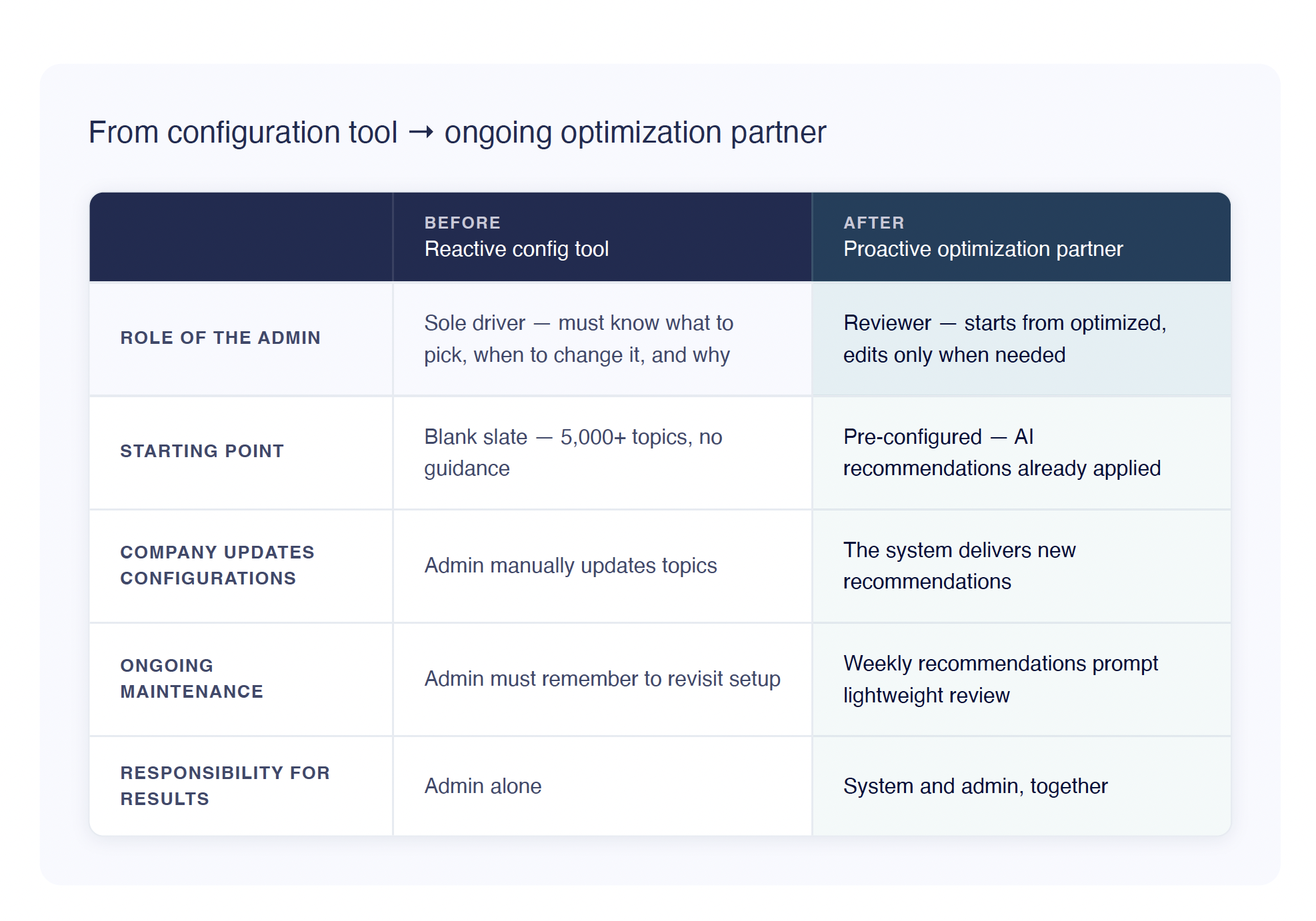
The old Intent setup experience relied on manual topic selection.
I reframed Intent from a configuration tool into a guided AI-powered onboarding system.
This shifted admins from building setup manually to reviewing optimized recommendations.
Designing a full system
Once AI recommendations became central to onboarding, the problem shifted from screen design to systems design.
Intent became a living system with complex states, edge cases, and evolving logic.
19 scenarios
across 5 trigger categories
Onboarding, updates, edge cases, partial and total failures, and multi-admin workflows.
To reduce design debt and simplify implementation, I aligned with Engineering around a centralized scenario map.
(instead of dozens of disconnected Figma flows)
🖼️ **[IMAGE — zoomed out, with zoomed in content for scale.
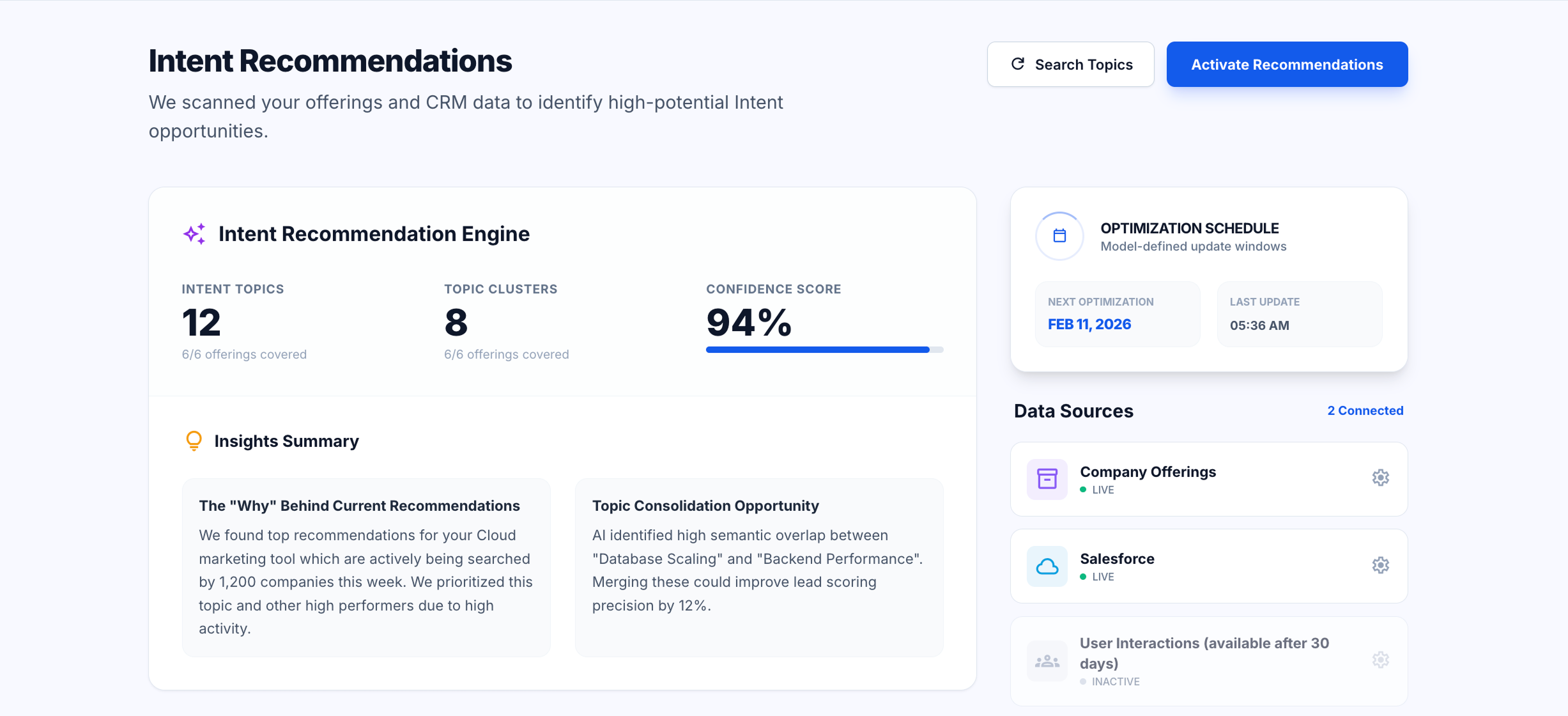
AI accelerated early exploration
Google Stitch helped me visualize the optimization partner V1
STRATEGIC DESIGN DECISION 1:
Two Types of Topics
The PM initially wanted one table for both offering-based and general intent topics.
As I mapped the workflows, it became clear there were two different mental models.
Trying to force both into a single table created cognitive overload and made large-scale setup harder for admins.
I proposed two optimized workflows over one bloated table.
Although it increased development scope, the simplified workflows reduced scanning effort and made onboarding easier to manage at enterprise scale.
Admin with Offerings configured
Quickly review and approve Intent topics across multiple Offerings.
Admin without Offerings configured
Easily review topics relevant to the business
STRATEGIC DESIGN DECISION 2:
Designing for clarity and trust
Early explorations used layered tabs to organize recommendation groups, but usability reviews showed the experience became visually exhausting and difficult to scan.
I shifted the experience into a stacked scrolling layout instead.
This created a clearer narrative flow:
admins could review recommendations in context
recommendation logic became easier to understand
the onboarding experience felt more aligned to their business
That moment of clarity mattered.
The easier recommendations were to understand, the more confidently admins adopted them — improving onboarding completion, signal quality, and long-term platform value.
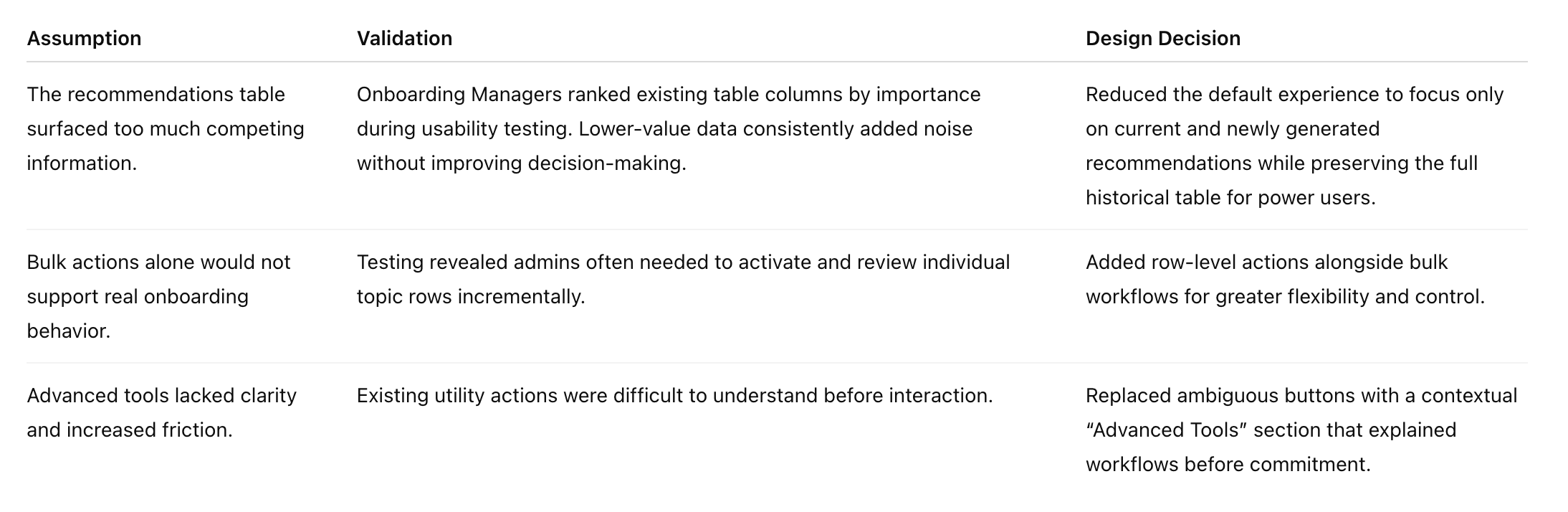
Usability Testing
Balancing simplicity with flexibility
Graphic will go here. (placeholder below)
Strategic design decision 3
Designing for cascading system states
As recommendation logic evolved, approval and removal actions became increasingly interconnected across Offerings and shared Intent topics.
Small changes could create unintended cascading effects:
removing shared topics
breaking recommendation relationships
creating conflicting states across workflows
The removal experience needed to be extremely clear and predictable.
Working closely with Engineering, I mapped cascading approval and removal states to close system gaps and reduce accidental disruption.
This led to more granular interaction patterns, including chip-level approval states for Offering-based topics.
Claude-assisted workflow testing helped rapidly uncover edge cases and state conflicts that would have been difficult to validate through static Figma flows alone.
In reflection
What this project became
What started as an onboarding redesign evolved into a scalable recommendation system designed around trust, flexibility, and long-term maintainability.
The final experience balanced:
AI-assisted onboarding
enterprise scalability
multi-admin workflows
progressive complexity
implementation-aware UX decisions